
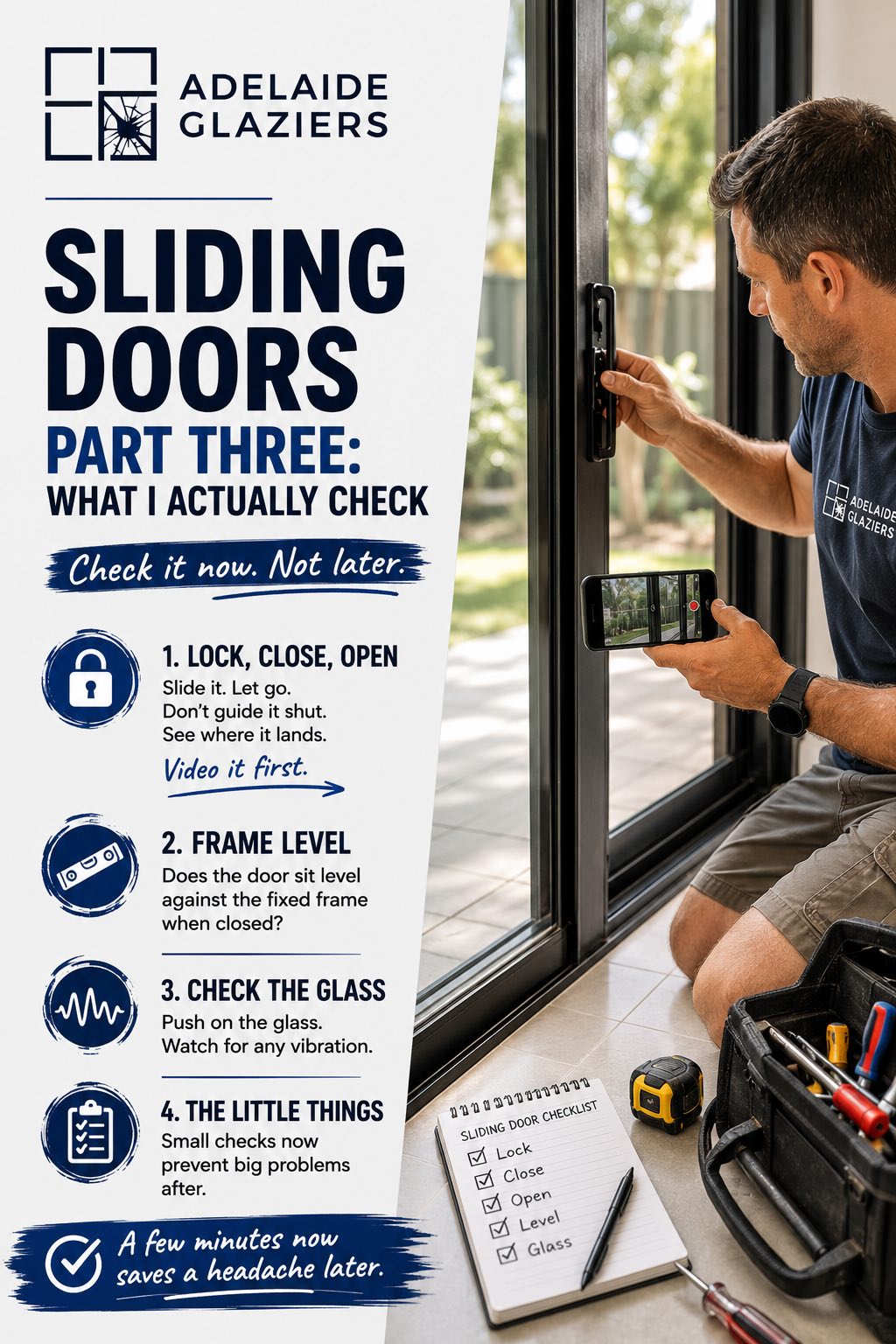
So here’s what I check, and why.
Does the door lock, close, and open properly. Simple as that sounds, it’s the first thing. And when you check it, don’t force it closed with your hand on it. Slide it and let go, see where it actually lands on its own. If you push it and guide it shut, you might convince yourself it locks fine when really it doesn’t, not without your help. Then the job’s done, the customer tries it themselves, and it’s different. At that point you’re buggered, especially if you’re trying to collect payment. It turns into a whole kerfuffle you didn’t need.
Take a video of it. Opening, closing, locking, all of it, before you touch anything.
Check whether the door frame sits level against the fixed frame when it’s closed. I got caught out on this one recently. I was fastidious, checked everything I could think of, and still missed this. It was slightly out. Turned out it actually had to sit like that, because the wheels were already adjusted as high as they’d go. Luckily the customer could see the whole thing was out themselves, so it wasn’t a mystery to him. I was straight with him too. Told him, yeah, I actually never checked that specifically. We figured it out together. I was lucky it worked out that way, but it’s exactly the kind of thing you can get stitched up over if you’re not careful.
Push on the glass and watch for the whole thing vibrating. That’ll tell you a lot about how loose or solid it actually is.
The problem is, when it’s urgent, and you just want to get in, get the job done, and get paid, you don’t think about all this. But these are the little things that matter. Once you start pulling a sliding door apart and putting it back together, sometimes it’s never quite the same again afterward. And there’s not always much you can do about that. All the more reason to check everything first, before you’ve touched a thing.