
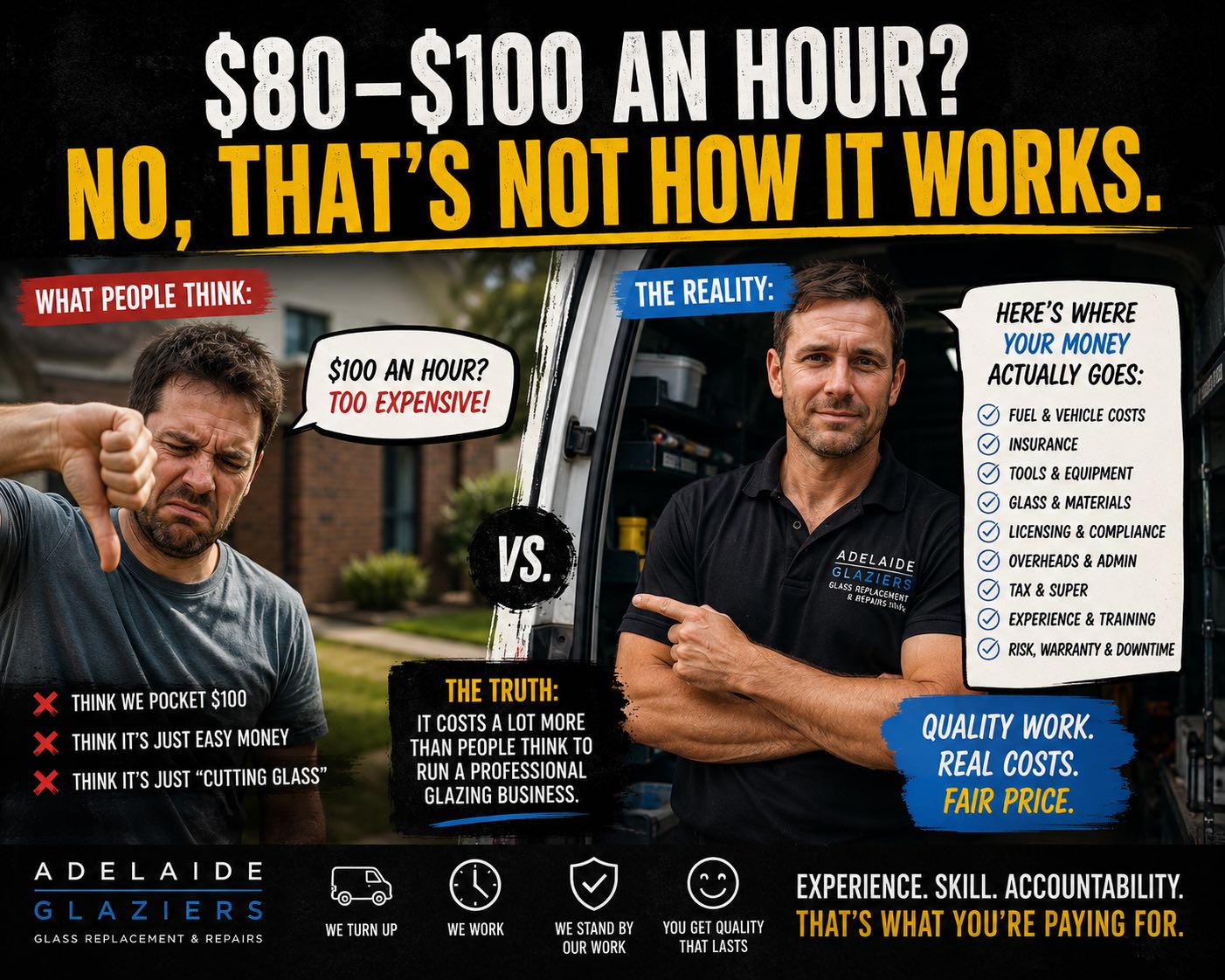
One thing I constantly hear is:
“Tradies charge $80 an hour.”
“Glaziers charge $100 an hour.”
“That’s expensive.”
Honestly?
That thinking is completely outdated and disconnected from reality.
Because the truth is:
if a glazier is only charging $80–$100 an hour in 2026, there’s a very good chance they’re either:
- barely making money,
- undercharging badly,
- or slowly going backwards financially without even realising it.
Revenue Is Not Profit
This is the biggest misconception customers have.
People hear:
“$100 an hour”
…and instantly assume the tradesman is personally making $100 an hour profit.
That is not how business works.
Not even close.
Out of that hourly rate comes:
- fuel,
- vehicle costs,
- insurance,
- public liability,
- tools,
- glass transport,
- administration,
- phones,
- advertising,
- bookkeeping,
- licensing,
- tax,
- superannuation,
- downtime between jobs,
- warranty risk,
- and general business overheads.
Every minute costs money in a trade business.
Especially mobile trades.
A Modern Glazing Business Costs Serious Money To Operate
Customers often compare modern trades to what things cost 10–20 years ago.
But everything has exploded in cost:
- fuel,
- vehicles,
- insurances,
- materials,
- labour,
- compliance,
- rent,
- software,
- taxes.
Yet somehow many people still expect trade pricing to operate like it’s 2005.
It doesn’t.
And honestly, I think many tradies themselves still haven’t fully adjusted either.
Glaziers Need To Charge More
I’ll say it directly:
I believe many glaziers are still undercharging.
At some point the industry has to acknowledge reality.
If businesses are constantly complaining:
- how expensive things are,
- how hard business is,
- how difficult it is to survive,
- how impossible staffing is,
- how everything costs more—
…then eventually pricing has to reflect that reality.
You cannot operate a modern glazing business on outdated pricing structures forever.
My Minimum Fee Is $350
This surprises some people.
But yes:
my minimum fee is $350 regardless of how small the window is.
That doesn’t mean every job is massively profitable.
It simply means there is a minimum operational cost to sending:
- a qualified glazier,
- a vehicle,
- tools,
- insurances,
- expertise,
- and business infrastructure
…to somebody’s property.
Whether the glass is small or large, many of the business costs remain exactly the same.
Cheap Pricing Usually Creates Bigger Problems
One thing I’ve learned over time is this:
Cheap pricing often creates:
- rushed work,
- stressed trades,
- poor communication,
- corners being cut,
- burnout,
- and businesses constantly struggling.
That helps nobody.
Not the customer.
Not the tradesman.
Not the industry.
Fixed Pricing Changed Everything For Me
I moved more toward a fixed-price model over time.
That took years to fully understand and implement properly.
But customers actually appreciate it far more than many people realise.
Instead of:
- vague hourly rates,
- uncertainty,
- or “watching the clock,”
…customers know the price upfront.
That creates clarity for both sides.
There Is A Difference Between Fair Pricing And Ridiculous Pricing
Of course, there are businesses that overcharge excessively.
Every industry has that.
But I also think there’s a huge difference between:
- unreasonable pricing,
and - realistic pricing that actually reflects the cost of operating professionally in 2026.
Those are not the same thing.
The Industry Is Changing
I think the glazing industry is slowly reaching a turning point.
The old idea of:
- cheap labour,
- low hourly rates,
- free everything,
- and endless underquoting
…is becoming unsustainable.
Customers are also starting to understand this more now.
Because everybody can see:
fuel costs more,
insurance costs more,
materials cost more,
and life generally costs more.
Trades are no different.
And honestly?
I think a lot of glaziers deserve to charge more than they currently do.