Adelaide Glaziers: Technical Resource Series for Australian Property Owners
1. Understanding the 6.38mm Composition
In the Australian glazing industry, 6.38mm Clear Laminated Glass is considered the “gold standard” for versatile safety. It is a composite material made by bonding two sheets of glass with a high-strength interlayer.
The specific “6.38” measurement refers to the total nominal thickness, calculated as follows:
3mm Float Glass: The exterior pane providing clarity and scratch resistance.
0.38mm PVB Interlayer: A Polyvinyl Butyral film that acts as the “glue” and safety barrier.
3mm Float Glass: The interior pane.
Why it matters: Because the interlayer is permanently bonded, the glass remains transparent. If broken, the glass fragments adhere to the PVB film rather than falling out of the frame.
2. Australian Standards & Compliance
All glazing in Australia must comply with AS 1288:2021 (Glass in buildings—Selection and installation). 6.38mm laminated glass is classified as a Grade A Safety Glass under AS/NZS 2208.
Under these regulations, 6.38mm (or thicker) safety glass is legally required in:
Doors: All glass doors and “side-lites” (windows next to doors).
Low-Level Glazing: Any window where the glass is within 500mm of the floor level.
Wet Areas: Bathrooms, ensuites, and laundry areas where slip-and-fall risks are high.
3. Security & Impact Performance
While 6.38mm is primarily installed for Safety (protecting people from shards), it also provides a baseline level of Security. Unlike standard 3mm or 4mm window glass that shatters instantly upon impact, laminated glass is difficult to penetrate.
An intruder attempting to smash a 6.38mm pane will find that the glass “webs” but stays in place. This forces a criminal to make significant noise and spend extra time trying to tear the interlayer—a major deterrent for smash-and-grab burglaries.
4. Beyond Safety: Acoustic & UV Protection
Homeowners often choose 6.38mm laminate for its secondary lifestyle benefits, which standard glass cannot offer:
Feature
How It Works
Benefit
UV Filtration
The PVB interlayer blocks ~99% of UV rays.
Reduces fading on carpets, curtains, and furniture.
Sound Dampening
The “sandwich” construction breaks up sound waves.
Quieter interiors compared to 3mm/4mm float glass.
5. Laminated vs. Toughened Glass
Both are Grade A Safety Glasses, but they behave differently:
Laminated: Stays together when broken. Can be cut to size by a glazier on-site, making it perfect for emergency repairs.
Toughened: 4-5 times stronger but shatters into small “pebbles.” It cannot be cut once made; it must be measured and ordered from a factory (taking 3-5 days).
6. FAQ
Is 6.38mm glass fully soundproof?
No, but it is a significant upgrade over standard glass. For high-noise areas near main roads, we recommend 10.38mm laminate or Double Glazing.
Can 6.38mm be used in bushfire zones?
It depends on the BAL (Bushfire Attack Level) rating. In many cases, specific toughened or fire-rated glass is required for higher BAL ratings.
A Point of View from a Qualified Glazier
Since starting Adelaide Glaziers, we’ve installed thousands of laminated glass panels. While it isn’t as strong as toughened glass, it’s still my preferred option. The only time we use toughened glass is when it’s required — such as for dog doors or specific applications that call for it.
Does Laminated Glass Break Easier Than Toughened?
Yes — significantly easier.
But here’s what I tell customers: if your glass is going to break from something like a lawn mower stone, a break-in, or rocks being thrown, then both laminated and toughened glass will break. If the impact is strong enough, the outcome is the same either way.
I take a straight-up, no-BS approach. I’d rather lose a job than recommend the wrong product.
That said, I will recommend toughened glass in certain situations — for example, if kids are constantly knocking or hitting the glass, or if it’s a high-risk area for repeated minor impacts. A reasonably firm basketball hit could break laminated glass, whereas toughened glass would be far less likely to fail under the same conditions.
Why Laminated Glass Is Still My #1 Choice
If I were building a home, I’d be using 6.38mm clear laminated glass as a minimum. For me, it’s the best balance of safety, security, and real-world performance.
The key difference is what happens after the glass breaks.
With toughened glass, failure is immediate and complete. It shatters into thousands of small pieces. Even if it appears to hold in place, it’s only temporary — a light push can cause the entire panel to fall out, leaving a dangerous mess and a completely open space. You’ll still be finding glass months later.
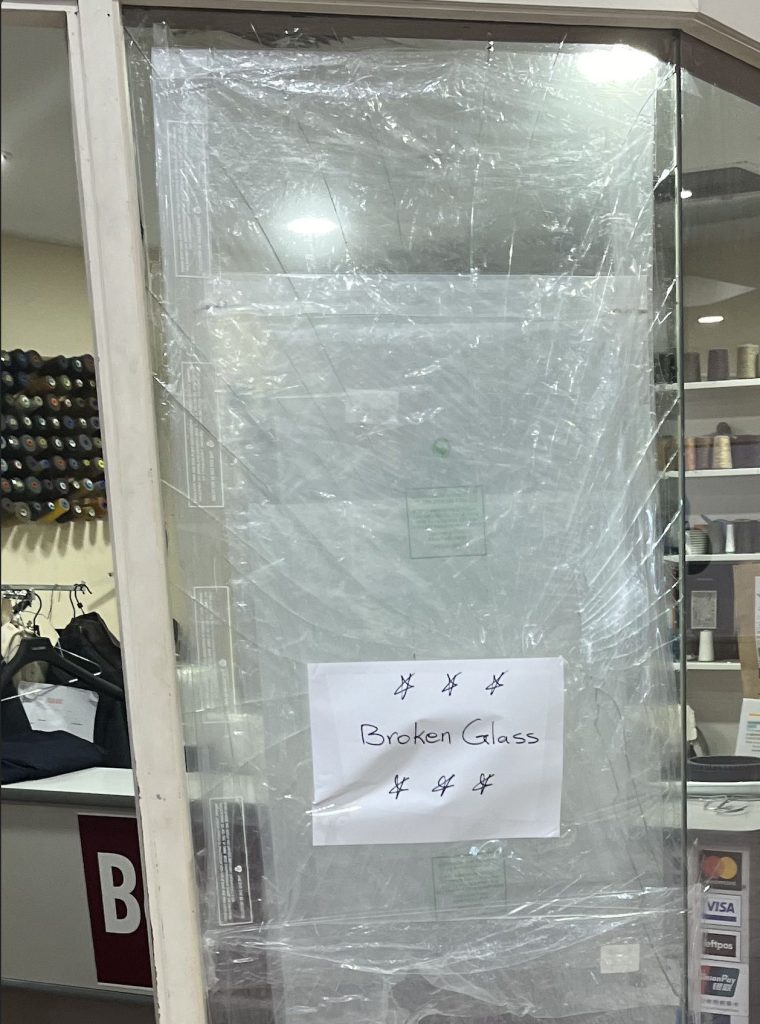
With laminated glass, although it breaks more easily on impact, it stays intact. The interlayer holds everything together. Even if the panel cracks while you’re away, the window or door remains in place — maintaining a level of security and protection.
Real-World Example
In the photo below, you’ll notice the glass is still holding together. The shop owner applied wrap, but this was largely cosmetic — the panel was already intact.
If this had been toughened glass, the result would have been very different. The window would likely have collapsed, creating an immediate security risk and an easy point of entry.